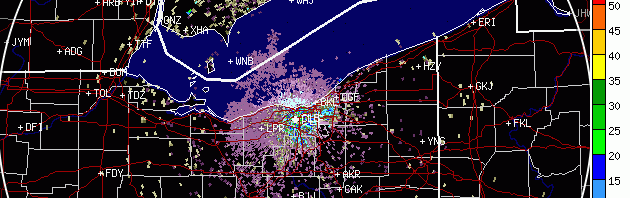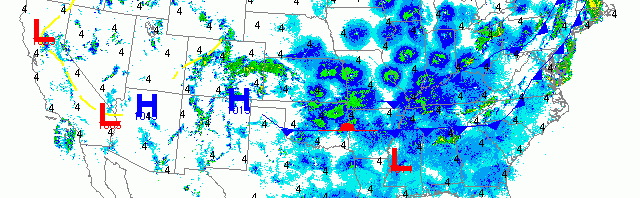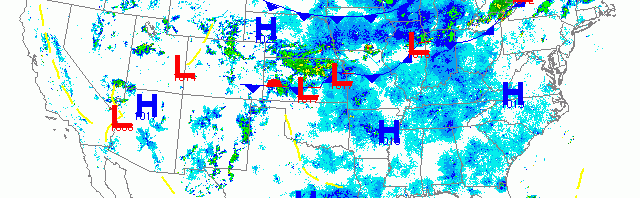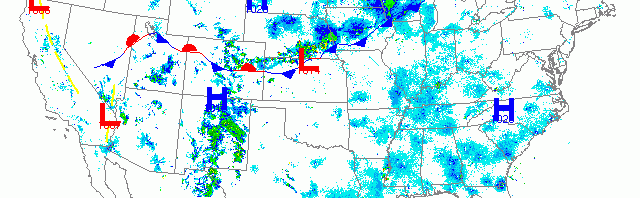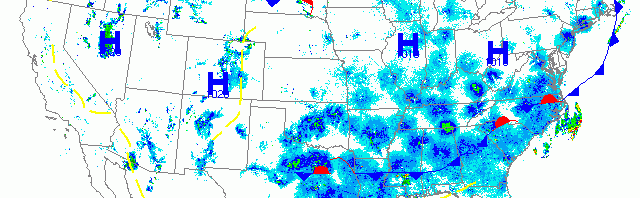
Well, my internet is still too slow for me to download the radar, but I can view still images ok. After checking the New Jersey radar it appears that birds were on the move after sunset last night, when the fast moving front overtook them around midnight.

The trajectory was generally SSE–>NNW, with the majority of birds coming in across the  western Delaware Bay. Fallout conditions may be present at sites along the southern Delaware River, and along the north and western Delaware Bay shore. Birds were also moving across the central and northern part of the state, and fallout conditions could be present there as well. If you experienced heavy rain between 11:00pm and midnight last night, you might want to check your local patch for fallout conditions.

Any reports would be greatly appreciated!

Good Birding

David

My radar feed is down and I can’t seem to download the radar to my computer. I’m in Florida, and we’re on a really crappy internet connection… hopefully I can remedy this soon.

In the meantime, use the real-time radar site link on the right side of the page…

Sorry for the inconvenience.

David

Favorable surface winds and clear skies opened the door to birds entering from the south, while less-than-optimal conditions over the northeast precluded much from leaving. The result should be a net gain of bird diversity and density across the region.

Here’s the radar from sunset last night through 5:30am this morning.

Frames are every 1/2 hour for reflectivity and velocity, and every hour for the regional composite. Click on the thumbnail to view the full-sized animation.
Base Reflectivity image from Fort Dix Base Velocity image from Fort Dix Base Reflectivity image from Dover AFB Base Velocity image from Dover AFB Composite Base Reflectivity image from the Northeastern USA

Birds were on the move across the Southeast and mid-Atlantic last night, while conditions over the Northeast were less than favorable. Both local radars show birds entering the radar after sunset and moving on a SSW–>NNE trajectory well into the morning hours.

As Susan Treesh pointed out early this morning (only the die-hards email me before 6:00am), the velocity images look “unblananced”. This is due to the upper level winds being northerly, and birds flying low to avoid them. There’s some N–>S movement across the radar, which represents the non-birds targets blowing with the wind, while most of the movement is S–>N, and represents bird migration.

With no precipitation present this morning, birds will be distributed across the landscape, making spring migrant traps the best bet for optimal birding conditions. I know I sound like a broken record, but Belleplain State Forest, Garret Mountain, and Sandy Hook should all be good today.

Good Birding

David

P.S. Come check out my migration forecast for the Mid-Atlantic on Birdcapemay.org

Please don’t forget to become a member of the Woodcreeper/Badbirdz flock today. Read the Become a Member post to find out more.

Birds are on the move, and they’re heading this way. I’ll be out in the field by 5:00am tomorrow, so use the real-time radar site to get your morning fix. Birding should be good at all spring migrant traps… more on the radar later tomorrow.

Good Birding
David

Migration patterns varied greatly with the differing wind directions across the state last night. Here’s the radar from sunset last night through 5:00am this morning.

Frames are every 1/2 hour for reflectivity and velocity, and every hour for the regional composite. Click on the thumbnail to view the full-sized animation.

Base Reflectivity image from Fort Dix Base Velocity image from Fort Dix Base Reflectivity image from Dover AFB Base Velocity image from Dover AFB Composite Base Reflectivity image from the Northeastern USA

The composite image indicated moderate levels of migration across the northeast and northern mid-Atlantic last night. Looking at the two New Jersey radars, the velocity images suggest birds to the south were being pushed west on strong easterly winds. In the central and northern part of the state, though, winds were light and variable, allowing birds to take a more SW–>NE trajectory. Therefore it looks like the best birding conditions this morning will be along the Delaware Bay to the south, Central New Jersey (such as Garret Mountain), and places along the northeast coast such as Sandy Hook.

Be sure to come on back and let me know how it goes out there!

Good Birding

David

P.S. Come check out my migration forecast for the Mid-Atlantic on Birdcapemay.org

Please don’t forget to become a member of the Woodcreeper/Badbirdz flock today. Membership has its privileges, so read the Become a Member post to find out more.

Winds were generally ENE over the region last night, with the exception of the northern third of the state where winds turned slightly SE. Light migration was apparent only in the northwest portion of the state, extending up into the Northeastern US. Here’s the radar from sunset last night through 5:30am this morning.

Frames are every 1/2 hour for reflectivity and velocity, and every hour for the regional composite. Click on the thumbnail to view the full-sized animation.
Base Reflectivity image from Fort Dix Base Velocity image from Fort Dix Base Reflectivity image from Dover AFB Base Velocity image from Dover AFB Composite Base Reflectivity image from the Northeastern USA

As I said before, not much going on except for some light movement over the northwest corner of the state. The general direction was from the SE–>NW, so bird densities should decrease along the inland areas of the northern part of the state, and possibly increase in the Highlands (although without systematically surveying the area, it is quite difficult to detect changes in density within the heavily forested northwestern part of the state).

Good Birding

David

P.S. Come check out my migration forecast for the Mid-Atlantic on Birdcapemay.org

Please don’t forget to become a member of the Woodcreeper/Badbirdz flock today. Membership has its privileges, so read the Become a Member post to find out more.